Jamie Sullivan
The DryJamie Sullivan is Luke Hadler’s friend and a farm worker whose statements become a key thread in the investigation of the Hadler family killings. First presented as a witness who had helped Luke shoot rabbits, Sullivan later gives an account of staying on his farm that conflicts with surveillance footage. The discovery that he was in town, and Dr. Leigh’s confirmation that they spent the afternoon together, changes the meaning of his earlier denials without establishing from these scenes alone what role, if any, he played in the killings.
Identity and Background
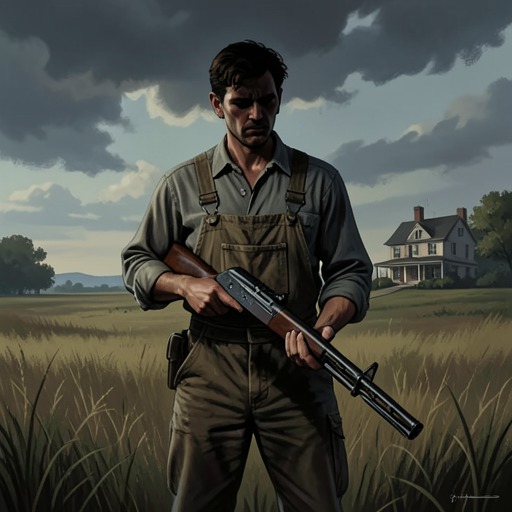
When Aaron Falk and Greg Raco visit Sullivan, he has already been working for more than four hours. They find him kneeling in dry soil, examining it closely, before he agrees to take them inside so he can check on his grandmother. Falk observes that Sullivan is in his late twenties, with thinning straw-blond hair, a wiry frame, and notably strong arms. His careful attention to the soil places him within the practical routines of farm life, while the drought-struck ground around him recalls the conditions shaping work in the district.
Sullivan’s connection to Luke is both personal and practical. He had helped Luke cull rabbits on his property, and he was the friend Luke was expected to be visiting on the afternoon of his death. Sullivan also says that he and Luke had made plans to shoot rabbits. This makes Sullivan an important witness to Luke’s movements, not simply an acquaintance who can confirm that they knew one another.
Luke’s Last Day and the First Account
The account of Luke’s planned rabbit-shooting outing reaches the police through search-and-rescue volunteers who knew both men. When contacted, Sullivan confirms that Luke had been at his farm but says Luke left a couple of hours before the call. At the time, Luke had not returned home or answered his phone, so the searchers did not yet know whether he was missing, in danger, or dead. Their uncertainty ended when a searcher found Luke’s truck in a clearing several kilometres away. Luke was dead in the back, and his registered gun was with him.
When Falk and Raco later question Sullivan, he begins by making clear that he would not knowingly have let Luke leave if he had suspected what was about to happen. He wants the investigators to understand that he had no warning. Raco does not accuse him of being able to prevent Luke’s death; he asks Sullivan to repeat his account so the officers can hear it directly. The exchange establishes the emotional and evidentiary stakes of the interview: Sullivan is a bereaved friend explaining the last known contact, but his version must still be tested.
One concrete detail checks out against the investigation’s ammunition inquiry. Asked what ammunition he supplied, Sullivan identifies it as Winchester. The distinction matters because the missing ammunition under investigation is Remington, so Sullivan’s stated supply does not match those missing rounds. This supports a specific part of his account, but it does not settle the broader questions about his movements or his knowledge of the events surrounding Luke’s death.
A Denial Set Against the Evidence
During the farm visit, Falk asks whether Sullivan left at all or received any visitors. Sullivan says that he did not: he had worked on the farm, finished outside, and eaten dinner with his grandmother. Falk notices her briefly look up in surprise when Sullivan denies leaving, then lower her eyes again. She appears asleep for the rest of the visit. The moment is slight and open to interpretation; it does not by itself prove what she witnessed. It does, however, give Falk a reason to remember the answer rather than accept it as an uncontested account.
The later discovery of CCTV footage provides a more definite contradiction. A pharmacy camera records a four-wheel drive entering a narrow Kiewarra alley at 4:41 p.m. on the Thursday of the killings, a little over an hour before Karen and Billy Hadler were found dead. The vehicle passes quickly, but when Constable Barnes slows and freezes the footage, Sullivan’s face is clear through the windshield. The image places him in town at a consequential time, in conflict with his claim that he remained at the farm.
The footage does not, by itself, explain why Sullivan was in the alley or establish what he did there. Its importance lies in converting a faint unease into a verifiable lead. Falk and Raco go to examine the location, a narrow road beside businesses and the doctor’s office, but the alley is deserted by the time they arrive. The recorded image, rather than anything visible at the scene, carries the investigation forward.
Dr. Leigh’s Disclosure and Sullivan’s Significance
The missing context emerges when Dr. Leigh admits that he was not alone in his flat that afternoon: he was with Sullivan. The two men had arrived at an anonymous door, waited until they were inside with it shut, and kissed. Dr. Leigh’s confirmation therefore supplies an explanation for Sullivan’s presence in town and identifies a relationship he had not disclosed to the investigators. The evidence establishes the meeting and the concealed relationship; it does not establish that the relationship explains every part of Sullivan’s account or that he had any involvement in the killings.
For Raco, the admission is both a frustration and a resolution of one immediate investigative puzzle. He reacts with disbelief and notes that the police have spent hours pursuing Sullivan’s story. The disclosure redirects the meaning of the CCTV evidence: Sullivan’s trip to town was connected to Dr. Leigh, not merely an unexplained journey that could be treated as evidence of a crime. At the same time, it confirms that Sullivan withheld a material fact while giving the police his account of Luke’s last day.
Sullivan’s narrative role rests on this double position. He is a friend who can provide the circumstances of Luke’s final known visit, and he is a witness whose denial is challenged by both a small reaction from his grandmother and a timestamped image. His later confirmation of the relationship with Dr. Leigh makes the concealment legible without erasing the earlier inconsistency. Through Sullivan, the investigation distinguishes between evidence that raises suspicion and evidence that supplies an alternative explanation: the footage proves his presence in Kiewarra, while Dr. Leigh’s admission clarifies whom he was with.